
Engineering Compassion at the End of Life
When the mind refuses to disengage, sometimes the only way out is to build a guide.

I was listening to a podcast recently where a famous musician was discussing their struggle with Obsessive-Compulsive Disorder (OCD).
I know what most people picture when they hear those three letters. They see the “classic” tropes: the neat freaks, the hand-washers, the people who check the stove seven times. But that wasn’t what they were describing. They were talking about “thought OCD”—what’s often referred to as Purely Obsessional OCD, or “Pure O.”
In that instant, I didn’t hear a celebrity speaking; I heard a mirror image of how my own brain has functioned for 54 years and now I can’t unhear it.
It’s the OCD that’s invisible to the naked eye. There are no physical rituals; instead, there are mental marathons. It’s a relentless, high-resolution loop that won’t—or can’t—be disengaged. It’s a thought pattern that catches on a fear or a “what-if” scenario and plays it over and over like a stylus stuck in the groove of a vinyl record.
The “Technology Geek” in the Deathcare Space
For nearly three decades, I’ve operated in the deathcare industry. I’m a self-professed technology geek, a “Director of Technology” who spends my time optimizing digital performance and building solutions for funeral service providers.
My ability to see the “structural gaps” in how we communicate about death providers a different perspective to families in search of understanding.
What they are actually seeing—though I didn’t know it had a label—was the byproduct of a mind that is constantly, obsessively scanning for the catastrophic.
In my world, a “what-if” isn’t just a fleeting anxiety; it’s a design challenge. Because my mind naturally plays out every possible tragic outcome on a loop, I am compelled to build systems to answer them. If I don’t build a solution, the loop doesn’t stop.
Channeled Into “Furry Mortals”
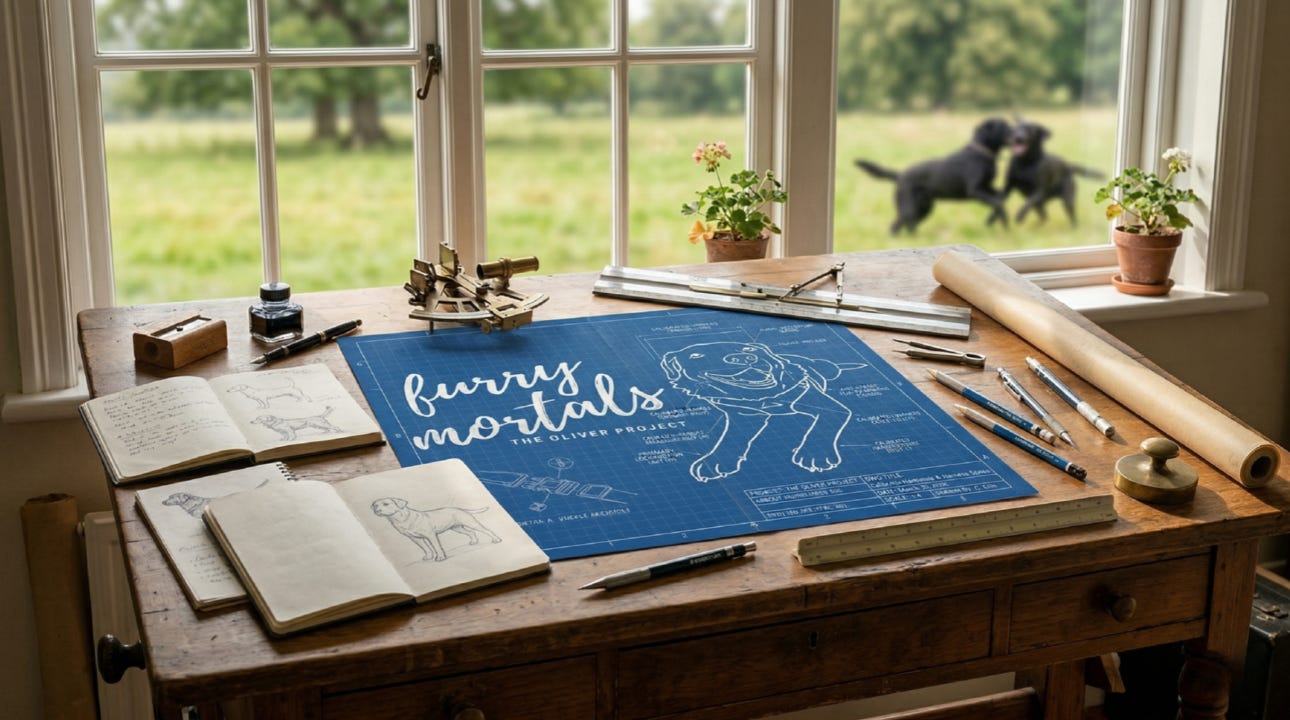
This mental wiring is exactly how Furry Mortals: The Oliver Project and The Furry Mortals Compass were born.
When my dog Oliver—my “Bubba”—passed away in late 2025, the “what-if” loops were deafening. Did I miss a sign? Was he in pain? What happens next? I realized that grieving pet parents are often plunged into a state of mental paralysis that looks a lot like OCD: a desperate, repetitive search for certainty in the face of the ultimate uncertainty.
I decided to use my “glitch” as a feature and put pencil to paper (usually a large butcher paper pad and lots of erasers).
I channeled that obsessive need for “high-resolution” answers into creating a guide that addresses the questions people are often too traumatized to even articulate. Furry Mortals: The Oliver Project isn’t just a book; it’s the architecture of my own anxiety, re-engineered into a tool for your peace. I built it because my brain demanded a manual for the chaos of losing a pet.
The Manual Override and What Lies Ahead
Today, my morning rituals are my manual override. Making coffee, listening to a specific playlist, and just being quiet with my pets close by (normally right on my lap) are the anchors that keep the loops from spinning out of control.
Being a writer/programmer/creator allows me to take the messy, jagged emotions of loss and organize them into something functional.
It turns out that a mind that thinks in infinite loops is often the same mind capable of building the most intricate, empathetic solutions for others.
I’ve spent 28 years helping the funeral industry, but I’ve realized my true calling is using this obsessive focus to support the people left behind when a pet dies.
Furry Mortals is just the beginning. There is something much larger on the horizon—a broader way to serve pet parents and provide the clarity that a racing mind so desperately craves.
My goal is to ensure pet parents never have to worry about the “what-ifs,” leaving them the space for the only thing that cannot be engineered: a gentle goodbye.